We trained GLM-5.3-Flash from a new base model and redesigned its architecture and training recipe around capability and efficiency. It introduces a hybrid architecture combining sparse and linear attention, adopts Manifold-Constrained Hyper-Connections to improve scaling efficiency, and is trained on our latest 30T-token multimodal corpus.
Before its official release, we evaluated GLM-5.3-Flash anonymously as Ox Alpha under real-world traffic, with all traffic served on Chinese AI accelerators.
Architecture for Efficient Inference
We designed GLM-5.3-Flash specifically for highly efficient inference. Compared with the GLM-4.5 series, which has a similar total parameter count, it reduces the number of active parameters from 32B to 18B and the number of layers from 92 to 45.
To reduce attention costs in long-context workloads, the model combines linear and sparse attention. Linear attention captures local dependencies through state modeling, while sparse attention uses a lightweight indexer to retrieve relevant information from the global context.
At context lengths of up to one million tokens, IndexPool further reduces indexer latency and memory overhead by compressing four cached key vectors into one through weighted pooling.
In our published comparison, GLM-5.3-Flash achieves approximately:
- a 3.0× reduction in attention compute compared with GLM-5.3;
- a 4.4× reduction in KV-cache size compared with GLM-5.3.
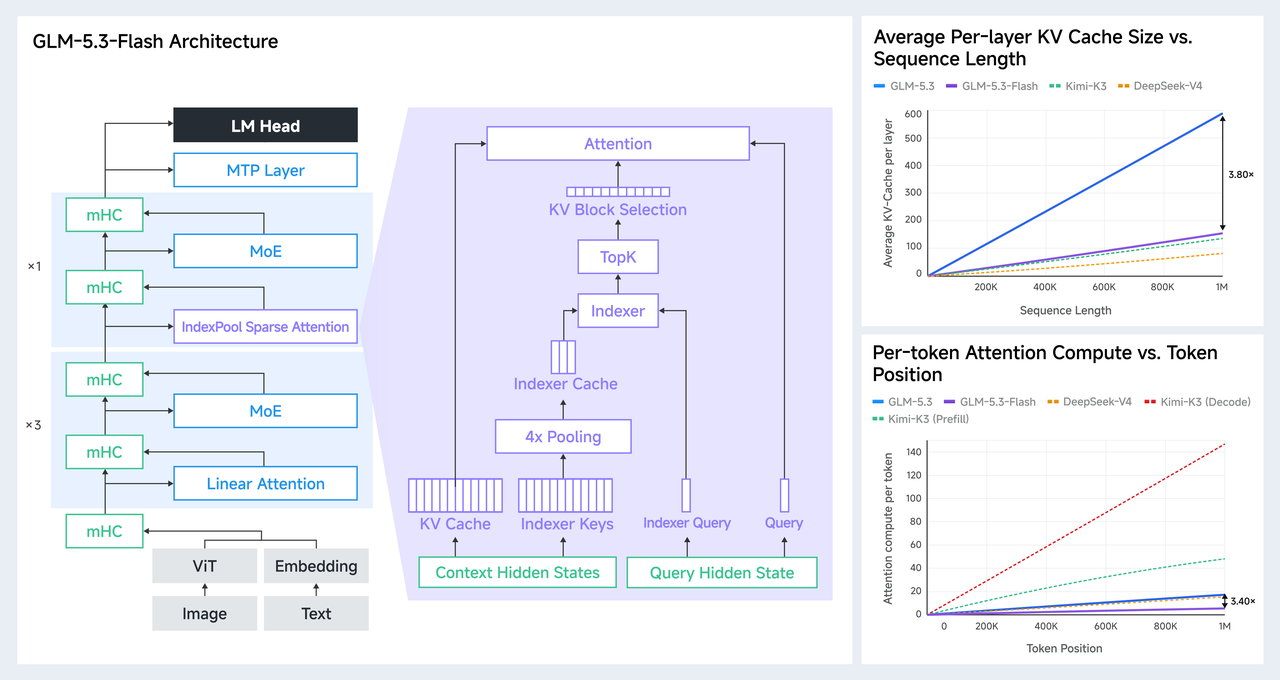
It has the lowest attention compute among the models included in our comparison. Its KV-cache footprint remains slightly larger than that of some comparable Flash-class models, leaving room for further optimization.
Together with our multimodal training corpus, these architectural changes enable GLM-5.3-Flash to deliver more capability with less compute.
Complex Tasks and Agentic Performance
In our published evaluations, GLM-5.3-Flash outperforms GLM-5.2 across coding, tool use, automation, and professional-work benchmarks.
| Benchmark | GLM-5.3-Flash | GLM-5.2 |
|---|---|---|
| Terminal Bench 2.1 | 84.3 | 81.0 |
| DeepSWE v1.1 | 63.4 | 46.2 |
| NL2Repo | 56.3 | 48.9 |
| Toolathlon Verified | 78.4 | 59.9 |
| AutomationBench v1.0.6 | 48.8 | 26.2 |
| Agents’ Last Exam | 26.3 | 20.4 |
| HLE with Tools | 55.3 | 54.7 |
| GDPval-AA v2 | 1773 | 1504 |
These benchmarks evaluate underlying capabilities such as planning, tool use, environmental feedback, and multi-step execution. The same capabilities can support research, file processing, data analysis, content production, and business workflow automation—not only software development.
All figures above come from our published evaluations. Actual performance may vary with inference settings, tools, execution frameworks, and evaluation environments.
Native Multimodal Intelligence
GLM-5.3-Flash learns text and visual information together from the pre-training stage, supporting text, images, video, and files.
Native multimodal training allows the model to interpret document structure, charts, interface state, layout relationships, and operational feedback, then use that information in subsequent reasoning and execution.
| Benchmark | GLM-5.3-Flash |
|---|---|
| OfficeQA Pro | 62.4 |
| CharXiv Reasoning with Tools | 89.4 |
| Chartography with Tools | 78.0 |
| BabyVision | 53.4 |
| MVBench | 77.8 |
| MMVU | 80.5 |
Bringing Visual Feedback into the Workflow
Visual understanding goes beyond recognizing what appears in an image. It allows the model to inspect the outcome of its work and determine what should happen next.
- For documents and presentations, the model can inspect rendered pages, evaluate information hierarchy, chart clarity, image cropping, alignment, and visual consistency, then continue refining the result.
- For data-analysis tasks, it can interpret both the underlying data and its visual presentation, checking whether a chart communicates the intended conclusion and whether data definitions remain consistent.
- For product and interface work, the model can observe the current state of a webpage or application, understand its structure and workflow, and translate visual findings into experience analysis, recommendations, or follow-up tasks.
Across multi-step workflows, visual feedback can also help the model determine whether an operation succeeded and select the next appropriate action. Vision therefore becomes part of execution and verification rather than a separate input capability.
Multimodal Intelligence for Professional Work
A large share of professional work involves heterogeneous visual and structured information, including documents, spreadsheets, presentations, dashboards, interfaces, and meeting artifacts.
GLM-5.3-Flash can decompose complex objectives, use tools, inspect results, and continue improving its output across the workflow—from source-material analysis to finished professional deliverables.
- For office tasks, the model can work with PPTX, PDF, DOCX, and XLSX files. In addition to generating content, it can inspect information structure, visual style, charts, image cropping, and page layout through rendered output. This allows it to identify text overflow, misalignment, overlapping elements, and inconsistent styling.
- For research and analysis, the model can organize public information, business materials, and structured data; distinguish known facts from assumptions and analysis; and turn the result into reports, presentations, spreadsheets, and other professional deliverables.
- For meetings and collaboration, it can work across meeting materials, notes, and existing files to organize decisions, action items, and supporting context, then continue developing an executable plan.
Serving at Scale on Chinese AI Chips
We have served real-world GLM-5.3-Flash traffic on a large-scale cluster of Chinese AI accelerators. To address memory and bandwidth constraints, we developed an inference engine optimized for the model’s architecture.
Our serving stack incorporates intra-node tensor parallelism, ReplaySSM, W8A8 quantization, hybrid INT8/FP8/BF16 cache quantization, Layer Split, and an Encode–Prefill–Decode disaggregated architecture.
With these optimizations, we achieved a threefold improvement in end-to-end serving performance compared with our initial baseline on the same hardware.
The model’s efficiency comes from the combined design of its architecture, multimodal training corpus, inference stack, and underlying hardware—not from any single technique.
Open Weights and Deployment
We have made the GLM-5.3-Flash model weights publicly available on Hugging Face under the MIT License.
GLM-5.3-Flash currently supports inference frameworks including SGLang, vLLM, and TokenSpeed. Framework compatibility and deployment options may continue to evolve; refer to our official model repository for the latest information.
GLM-5.3-Flash is now available in AutoClaw, bringing efficient native multimodal intelligence into real work.