

Risk rarely arrives all at once. It may be contradictory figures in a document, a cluster of accounts tied to one device, or a slow shift in a company's operating data. By the time delinquency or fraud shows up, the risk has been building for a long time.
Financial risk management means spotting these signals early and turning them into decisions: approve, decline, request documents, adjust the limit, or escalate for review. AI now helps with unstructured documents, anomaly detection, linked-risk analysis and early warning. But a better model does not automatically mean better risk management: if data definitions, thresholds, human review or audit trails fail, a more advanced model just creates more complex problems. The real task is reorganizing how data, models, policies and people work together.
1. Where to Start: Costly, Verifiable Tasks
Start from the business problem. AI adds the most value where work used to be expensive: extracting risk information from contracts and financial statements, detecting linked anomalies across devices, accounts and fund flows, and assembling scattered information into usable evidence. A good first use case meets four conditions:
- Measurable cost: you can quantify fraud losses, credit losses, cost per review or case handling time.
- Verifiable outcomes: labels, case outcomes and review records are reasonably complete.
- Actionable output: results can trigger a block, a document request, an escalation or a change in review priority.
- Controllable errors: you can run a pilot, keep human review, cap exposure and roll back quickly.
Document review support, fraud case consolidation, post-loan early warning and review queue prioritization qualify. Fully automated credit approval, where a wrong call causes irreversible loss, does not.
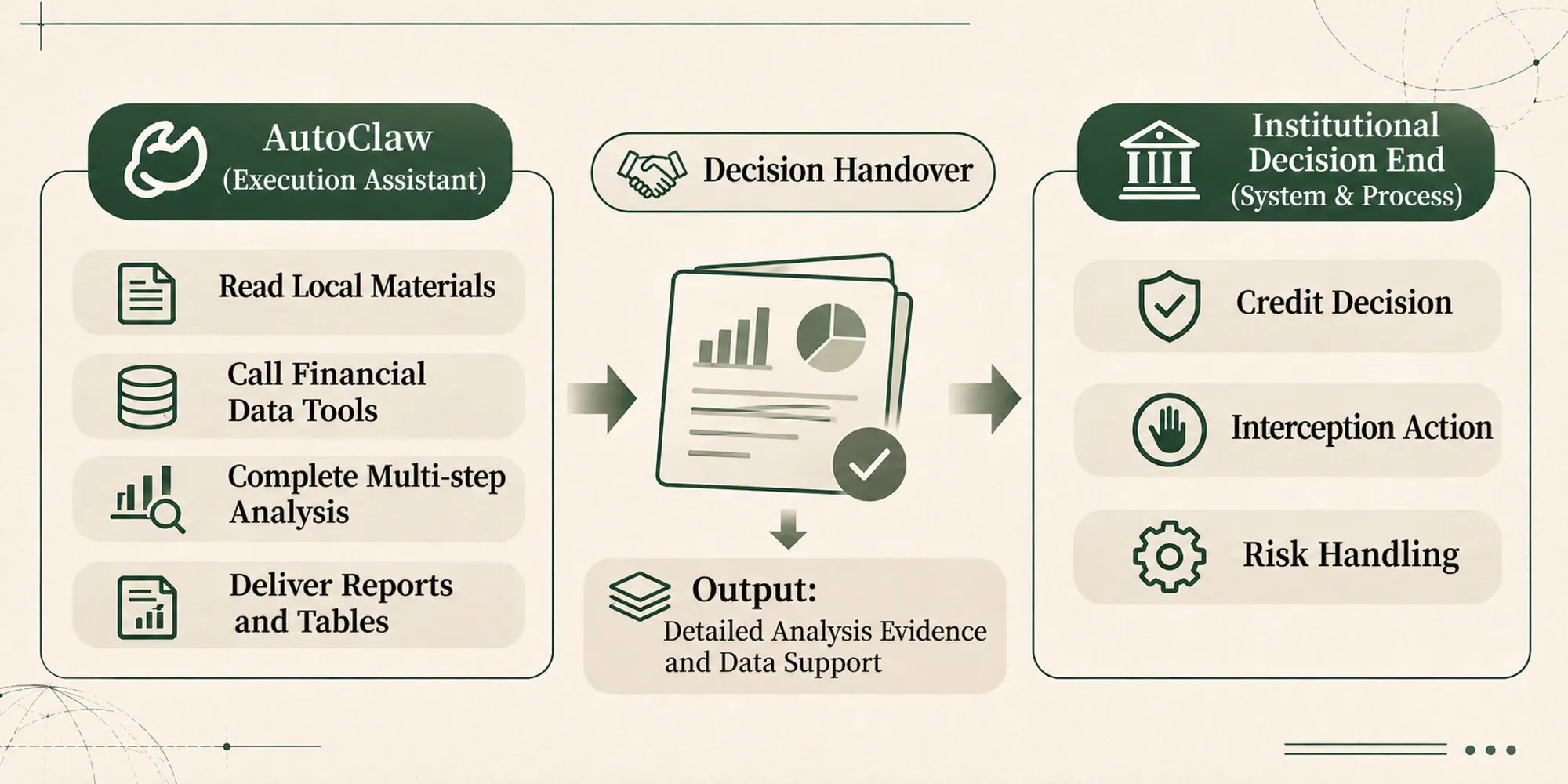
The first three are evidence work, where AutoClaw fits most easily. It runs on the reviewer's desktop and works directly with their files and data exports, so you can pilot it on historical cases without touching the production decision system, and stop it without disrupting anything.
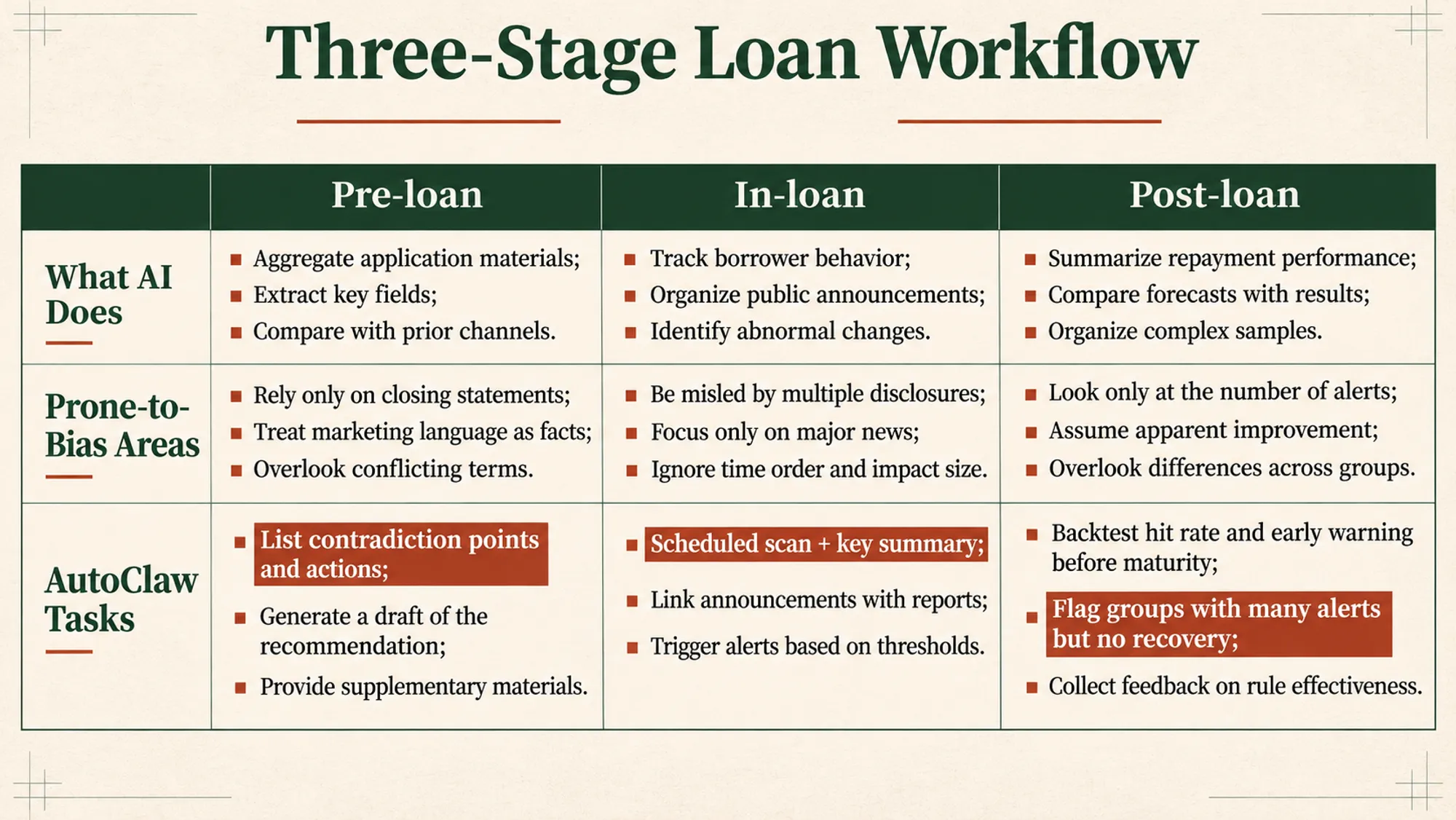
2. AI Credit Risk Across the Loan Lifecycle
Each stage has a different goal, so AI's output, its failure modes and AutoClaw's role differ:
3. The Boundary for Generative AI: Evidence, Not Authorization
Generative AI should handle evidence, not make the final decision. It can compile documents, flag conflicts, cite source passages and draft questions to verify; the final call still goes through authorization. Three boundaries matter, and here is how AutoClaw handles each:
- Every conclusion traces back to evidence. Model guesses must never be presented as facts. AutoClaw's Financial Analysis mode requires market, financial, filing and company registry data to come from connected financial data tools, and cites the file and passage behind each conclusion.
- Generation is separate from decision. Writing a risk report and approving credit are different permissions. AutoClaw delivers reports, checklists and recommendations and does not connect to approval actions; its own high-risk operations, such as deleting files or editing scheduled tasks, can require confirmation in security settings.
- Low confidence goes to a human, explicitly. When data is missing or conflicting, surface the uncertainty instead of filling in a plausible answer. If a data source fails, AutoClaw states the gap rather than inventing a number.
4. Evaluating Risk Models: Offline Metrics Are Not Business Results
AUC, KS, precision and recall show whether a model works on historical data. After launch, the question is whether the risk-return trade-off has improved. Track four metric groups together, since optimizing one often worsens another, such as lower fraud at the cost of more false declines.
| Dimension | Key metrics |
|---|---|
| Risk performance | Bad debt rate, fraud loss rate, recall on high-risk cases, alert lead time |
| Customer impact | Approval rate, false decline rate, document request rate, complaints and appeals |
| Operational efficiency | Cost per review, automation rate, manual review time, case backlog |
| Stability & governance | Missing data rate, feature and model drift, override rate, rollbacks |
Two common mistakes: mixing up attribution, since product, channel and macro changes also move results (use control groups or champion-challenger testing); and skipping a preset observation window, since risk outcomes lag and early gains prove little.
Give AutoClaw the exports for pilot and control groups, and it builds the comparison table across all four groups, marks which metrics are still too early to call, and drafts an editable evaluation report for the model owner to sign off.
5. Monitoring After Launch: Data, Model and Policy
Launch is where risk exposure begins. Monitor three layers, each with a predefined response:
| Layer | Typical signals | Response |
|---|---|---|
| Data | Missing fields, abnormal values, delays, source or definition changes | Fix upstream, switch to a backup source, pause affected automated decisions |
| Model | Rising drift metrics such as PSI; actual performance deviating once labels mature | Investigate, retrain or recalibrate, roll back if needed |
| Policy | Changes in rules, review ratios or actions shifting approval rates or risk | Replay historical cases, adjust thresholds, reduce automation |
Many performance drops start with upstream data, not the algorithm. Before launch, decide who receives alerts, who can pause decisions and what must be verified before resuming.
AutoClaw handles first-pass triage. A scheduled task has it read monitoring reports daily; when missing data or PSI crosses a threshold, it compares recent distributions, judges whether the cause is upstream data or a customer shift, and sends findings to the owner. Pausing decisions stays with authorized staff.
6. Meeting Audit Requirements
LLMs in finance are often criticized as black boxes. Explainability here means being able to reconstruct any decision afterwards. A complete decision record includes:
- The data used and its timestamps
- Rules triggered and their versions
- Model, feature and parameter versions
- Scores, reasons and confidence output by the system
- Manual review and override records
- The final action and its authorization basis
- Subsequent risk outcomes and appeal results
For LLM steps, also keep input sources, retrieved evidence, template versions and output checks, and set data access, external model calls and retention before launch.
AutoClaw can sample decision records against this checklist, list records with missing fields or mismatched versions, and compile a decision reconstruction report for a disputed case. Its own use should be governed too: it runs on employees' computers, keeps outputs in a local workspace and labels data sources, but institutions should still define which data it may process and which model service it uses.
7. A Four-Stage Roadmap with Exit Criteria
Move through four stages, advancing only when each stage's exit criteria are met. AutoClaw's role changes along the way:
| Stage | What to do | Exit criteria | AutoClaw's role |
|---|---|---|---|
| 1. Baseline | Pick a well-defined use case; record current losses, approval rate, review cost and handling time; fill gaps in labels and decision logs | Baseline complete and usable for before-and-after comparison | Organize historical data, calculate baseline metrics, list gaps in labels and logs |
| 2. Assist mode | AI only produces risk signals, summaries or recommendations without changing decisions; human-vs-AI comparison exposes data issues, evidence gaps and error types | Main error types explained, with fixes planned | Core stage: generate recommendations on the same cases on reviewers' desktops, compare with human conclusions, summarize disagreements |
| 3. Limited automation | Automate only well-defined, low-risk cases and keep human review for the rest; set exposure caps, anomaly thresholds, rollback conditions and owners | Risk and customer metrics no worse than the control group | Automation runs in the institution's decision system; AutoClaw keeps preparing evidence for escalated cases and produces pilot comparison reports |
| 4. Continuous improvement | Feed overrides, fraud investigations, appeals and post-loan outcomes back into data and policy; review models and rules regularly | Evaluation and rollback run as routine | Scheduled evaluation, drift and override analysis reports |
What matters is not speed but keeping automation in line with evidence strength, risk level and organizational capability. A more realistic goal than "no human review" is letting machines handle repetitive work so experts can focus on complex cases. AutoClaw takes the first half: document checks, data lookups, evidence assembly and reporting.
Where to start: Install AutoClaw on your computer, turn on Financial Analysis mode, and pick a batch of historical cases with known outcomes. Have it produce a recommendation for each case in assist mode, then compare with the human decisions. Where they disagree most is usually where your data and process need work.


